


Aligning with the Celestial Rhythm of the moon
For thousands of years, our ancestors looked up at the night sky not for romance, but for guidance. The Moon was not a cold rock in the sky, it was the pulse of nature itself. It whispered to the oceans, stirred the sap in the trees, timed the planting of seeds, and measured the flow of blood in women’s bodies. In the villages, elders would say: “The Moon is the drumbeat of the Earth.”
Let’s dive deep into what this celestial body represents. Somewhere between modern lights and busy schedules, we lost the rhythm. But the Moon never stopped dancing. And when you learn to move with her, she can awaken a flow in your life that is both powerful and deeply gentle.
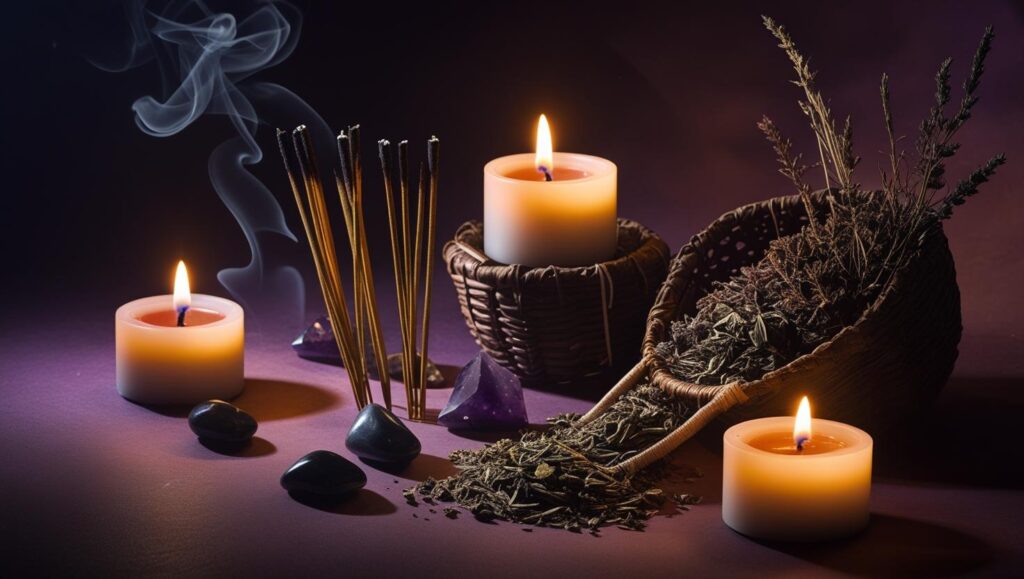
This article will show you how to dress, light, and scent your life according to the Moon’s four main phases, combining ancestral knowledge with the vibrational support of candles, incense, herbs, and crystals. Each element works together to open a doorway for intention, healing, and connection to the Mother of the Zodiac. Let’s go for it.
1. New Moon — Planting the Seed
Energy: Beginnings, vision-setting, and inward reflection.
Vibe: Soft, dark, fertile — like rich soil ready to receive the first seed.
- Dress:
Wear deep blues or soft black fabrics—think flowing dresses, loose robes, or scarves. Natural cotton or linen works best to let your skin breathe and your aura reset. - Candle:
White or silver to invite clarity and new blessings. - Herbs:
Mugwort for opening intuition, rosemary for cleansing mental clutter. - Crystal:
Moonstone to connect with lunar energy, Labradorite to spark new possibilities.
2. First Quarter — Action & Momentum
Energy: Taking the first steps, building courage, testing your intentions.
Vibe: Bright, forward-moving, slightly electric.
- Dress:
Wear vibrant reds or earthy greens to stir movement and confidence. - Candle:
Gold or green to energise and support growth. - Herbs:
Basil for prosperity, cinnamon for motivation. - Crystal:
Carnelian for courage, Citrine for inspired action.
3. Full Moon — Illumination & Power
Energy: Celebration, manifestation, spiritual harvest.
Vibe: Radiant, magnetic, overflowing.
- Dress:
Flowing white or silver garments that shimmer in the moonlight. Add beads or metallic accents to reflect the fullness of the moment. - Candle:
White or purple for spiritual elevation. - Herbs:
Jasmine for attracting blessings, lavender for balance and gratitude. - Crystal:
Clear Quartz for amplifying intentions, Amethyst for spiritual wisdom.
4. Last Quarter — Release & Renewal
Energy: Letting go, closing cycles, cleansing.
Vibe: Quiet, reflective, and freeing.
- Dress:
Shades of brown, grey, or deep indigo—grounding, protective colours. - Candle:
Black for banishing negativity, deep blue for inner truth. - Herbs:
Sage for cleansing, bay leaves for releasing old patterns. - Crystal:
Obsidian for protection, Smoky Quartz for clearing emotional residue.
This isn’t just about fashion or decoration—it’s a way to embody the Moon’s rhythm. By dressing in her colours, lighting candles in her honour, and surrounding yourself with the herbs and crystals that echo her current energy, you create a living ritual.
And the more you live in tune with the Moon, the more you’ll feel that she’s tuning you—gently guiding you back to your highest self, just as she guided the tides and the seeds for millennia.
Let us look into the mythology and symbolism of what the moon really means to abantu. The answer always hides in the nythology.
The Moon in Kemet
In Kemet, the Moon wasn’t just a light in the sky—it was a living power, a measure of time, balance, cycles, and transformation. Unlike the Sun (Ra), which is constant and dominant, the Moon shifts, waxes, wanes, disappears, and returns. This gave it meaning in the sciences of:
- Cycles of time (calendar, festivals, agriculture)
- Spiritual growth (initiation, hidden wisdom, rebirth)
- Balance of opposites (order vs. chaos, masculine vs. feminine, seen vs. unseen)
The Moon through Tehuti
Tehuti, diety of wisdom, writing, and divine order, is often linked with the Moon (sometimes even depicted with a lunar disk on his head).
Symbolism of the Moon through Tehuti:
- Timekeeper & Recorder: The waxing and waning moon gave Tehuti the role of measuring time and recording cycles, crucial for calendars, rituals, and cosmic order (Ma’at).
- Illumination of the Dark: Just as the Moon reflects the Sun, Tehuti reflects Ra’s divine light into the darkness—symbolizing how wisdom brings clarity in the unknown.
- Hidden Knowledge: The Moon disappears (dark moon) and reappears (crescent), a metaphor for esoteric wisdom—knowledge hidden, then revealed to initiates.
- Mediator: In myths, Tehuti often mediates conflicts among the gods. The Moon’s balance between light and dark mirrors his role as a cosmic diplomat who brings harmony.
But did you know that Tehuti has a feminine form?
Who is Seshat/Sechet?
- She is the feminine counterpart of Tehuti.
- Diety of writing, record-keeping, measurement, architecture, and sacred knowledge.
- She wears a seven-pointed star/flower emblem on her head, sometimes with a crescent (showing her lunar link).
- Together with Tehuti, she ensures the cosmic order (Ma’at) is written into existence and preserved.
The Moon through Tehuti and Seshat
When you place Tehuti and Seshat together, they form the masculine and feminine poles of lunar wisdom.
Tehuti (Masculine / Lunar Principle)
- The Moon as Mind: Order, rhythm, calculation, measurement of time.
- The Waxing/Waning Cycle: He records, calculates, and maintains cosmic balance.
- Symbolic Role: The logos — the divine word that illuminates.
Seshat (Feminine / Lunar Principle)
- The Moon as Womb of Wisdom: She receives, records, and births knowledge into form.
- The Crescent as Vessel: Represents receptivity, the hidden, the intuitive aspect of the Moon.
- Symbolic Role: The matrix — the keeper of memory and the storehouse of divine wisdom.
Their Union
- Together, Tehuti and Seshat embody the Moon as both Speaker and Listener, Scribe and Recorder, Light and Vessel.
- They are the cosmic library: Tehuti dictates, Seshat inscribes.
- Spiritually, they represent the balance of the left and right brain:
- Tehuti = logic, order, measurement.
- Seshat = intuition, receptivity, memory.
So when we talk about the Moon through Tehuti and Seshat, it’s the union of masculine reason and feminine intuition in the cycle of time, mystery, and sacred knowledge.


